

Vertical Storage
The Most Underused Asset in Your Facility
Running Out of Space?
Walk into almost any warehouse or fulfillment center and you’ll see the same thing:
A lot of activity at ground level… and a whole lot of unused space above it.
It’s easy to focus on what’s happening right in front of you: picking, staging, packing, shipping. That’s where the action is. That’s where the pressure is.
But if you step back and look at the full picture, one question becomes hard to ignore:
Why is so much of the building sitting empty?
The Space You’re Not Using
Most facilities are designed with vertical capacity in mind. High ceilings. Open spans. Structural support. It’s all there.
But in many cases, that vertical space goes largely unused.
Why?
Because it’s not as simple as stacking higher.
Using vertical space effectively requires planning, structure, and systems that support how your operation actually works.
Without that, it becomes easier to stay at ground level, even if it’s costing you.
The Real Cost of Staying Flat
When you rely only on floor-level storage, a few things start to happen:
• Inventory spreads out instead of stacking up
• Travel distances increase
• Picking paths become longer and less efficient
• Space fills up faster than it should
Eventually, the facility feels “full”, even though there’s still plenty of usable volume overhead.
That’s when expansion conversations start.
But often, expansion isn’t the answer.
Thinking in Cubic Space, Not Square Feet
Most operations measure capacity in square footage.
But fulfillment performance is driven by cubic space.
That shift in thinking changes everything.
Instead of asking, “How much floor space do we have?” You start asking, “How much storage volume are we actually using?”
That’s where vertical storage solutions come into play.
Let’s Make Your Next Project Easier
or talk to a Borroughs expert today at 800.748.0227
What Vertical Storage Actually Does
When implemented correctly, vertical storage doesn’t just add capacity, it improves flow.
Multi-level systems, high-rise shelving, and mezzanine-supported structures allow you to:
• Store more inventory in the same footprint
• Reduce horizontal sprawl
• Bring high-frequency items closer to pick paths
• Separate workflows across levels
It’s not about going up just to go up.
It’s about organizing space in a way that supports how your operation runs.
Why This Matters for Throughput
Throughput isn’t just about speed, it’s about efficiency.
And efficiency depends on how quickly your team can access and move inventory.
When everything is spread out, it takes longer to:
• Find items
• Walk between picks
• Replenish stock
• Stage orders
But when storage is structured vertically and intentionally:
• Travel distances shrink
• Access improves
• Congestion decreases
Everything moves smoother.
Where Most Operations Get Stuck
The biggest barrier to vertical storage isn’t cost.
It’s uncertainty.
Questions like:
• How will this integrate with our current layout?
• Will it disrupt our workflow?
• How complex is installation?
• Can we scale it over time?
These are valid concerns.
And they’re exactly why planning matters.
Let’s Make Your Next Project Easier
or talk to a Borroughs expert today at 800.748.0227
How Borroughs Helps Solve the Puzzle
Borroughs approaches vertical storage as part of the overall system, not a standalone add-on.
With multi-tier shelving, high-rise systems, and mezzanine-supported structures, the focus is on:
• Aligning storage with workflow
• Supporting high-throughput environments
• Creating scalable solutions
• Integrating with picking and automation systems
The goal isn’t just to build up.
It’s to build smarter.
A Better Way to Look at Your Facility
If your operation is feeling tight, it’s worth stepping back and asking:
• How much vertical space are we actually using?
• Are we maximizing our building’s full capacity?
• Is our layout forcing unnecessary movement?
Because the answer might not be more space.
It might be better use of the space you already have.
Final Thought
The most valuable storage space in your facility might be the space you’re not using.
And once you start thinking vertically, it’s hard to go back.
Want to See What’s Possible?
Take a closer look at how vertical storage can transform your operation on our page Borroughs.com or call 800.748.0227.
Let’s Make Your Next Project Easier
or talk to a Borroughs expert today at 800.748.0227
FAQs
What is vertical storage in a warehouse or fulfillment center?
Vertical storage refers to shelving, multi-level systems, mezzanines, and other solutions that utilize the unused height within a facility to increase storage capacity without expanding the building footprint.
How can I increase warehouse storage capacity without expanding my building?
One of the most effective ways is to utilize vertical space through multi-level shelving systems, mezzanines, or high-rise storage solutions. This allows facilities to add capacity while remaining within their existing footprint.
Why is vertical space important in a fulfillment center?
Vertical space is often one of the most underutilized assets in a facility. Using it effectively can increase storage density, reduce travel distances, improve organization, and support higher throughput.
What are the benefits of multi-level storage systems?
Multi-level storage systems help maximize cubic space, improve inventory organization, reduce floor-level congestion, and create additional picking and storage capacity without facility expansion.
How do mezzanines increase storage capacity?
Mezzanines create additional usable levels within a facility, allowing operations to add storage, picking areas, workstations, or inventory staging zones without increasing the building footprint.
How much additional capacity can vertical storage provide?
The amount varies by facility, but many operations can significantly increase storage capacity by utilizing available overhead space through high-rise shelving, catwalk systems, or mezzanines.
What industries benefit from vertical storage solutions?
Vertical storage is commonly used in fulfillment centers, distribution centers, e-commerce operations, automotive parts distribution, manufacturing facilities, and third-party logistics (3PL) environments.
How does vertical storage improve warehouse efficiency?
By organizing inventory vertically, facilities can reduce travel distances, improve inventory accessibility, increase storage density, and create more efficient workflows.
What is the difference between a mezzanine and a multi-level shelving system?
A mezzanine is a free-standing elevated platform that creates additional floor space, while a multi-level shelving system integrates storage and access levels directly into the shelving structure.
When should a company consider a multi-level storage system?
Companies should consider multi-level storage when inventory growth is outpacing available floor space, picking paths are becoming inefficient, or facility expansion is being considered.
Can vertical storage support warehouse automation?
Yes. Many multi-level storage systems are designed to integrate with conveyors, barcode scanning, robotic picking systems, and other warehouse automation technologies.
How do I know if my facility is a good candidate for vertical storage?
If your facility has unused overhead space, growing inventory levels, increasing SKU counts, or limited room for expansion, vertical storage may be an effective solution.
warehouse shelving, industrial shelving, warehouse storage solutions, industrial storage systems, warehouse shelving systems, distribution center shelving, fulfillment center shelving, warehouse storage racks, industrial storage racks, steel shelving systems, heavy duty shelving, commercial shelving systems, warehouse organization systems, warehouse storage equipment, warehouse racking systems, pallet rack systems, pallet racking, selective pallet rack, drive-in racking, push back racking, carton flow rack, gravity flow rack, pick module systems, multi-level pick module, order picking systems, picking efficiency solutions, fulfillment center storage solutions, distribution center storage solutions, warehouse space optimization, warehouse storage design, warehouse layout design, warehouse capacity expansion, warehouse mezzanine, shelf supported mezzanine, industrial mezzanine systems, multi-tier shelving, high density storage systems, vertical storage solutions, warehouse automation storage, ASRS storage systems, inventory storage systems, parts storage systems, small parts storage, bin shelving systems, bulk storage shelving, long span shelving, rivet shelving, warehouse shelving manufacturer, custom warehouse shelving, industrial shelving manufacturer, how do I increase storage capacity in my warehouse, how can I add storage without expanding my building, best shelving for a fulfillment center, best storage system for a distribution center, how do I improve picking efficiency, warehouse layout ideas for faster picking, how to maximize warehouse space, high density storage solutions for warehouses, industrial shelving for ecommerce fulfillment, storage solutions for growing distribution centers, warehouse shelving systems, fulfillment center storage solutions, distribution center shelving, pick modules and picking efficiency, mezzanines and vertical space utilization, warehouse space optimization, industrial storage systems, custom warehouse storage solutions.
Let’s be honest: if your parts department feels like a treasure hunt every time someone needs a fastener, you’ve already lost time, money, and maybe even customers. Techs get frustrated. Service slows down. And at the end of the day, what should be an efficient operation feels like organized chaos.
Walk into almost any warehouse or fulfillment center and you’ll see the same thing:
A lot of activity at ground level… and a whole lot of unused space above it.
It’s easy to focus on what’s happening right in front of you: picking, staging, packing, shipping. That’s where the action is. That’s where the pressure is.
But if you step back and look at the full picture, one question becomes hard to ignore:
Why is so much of the building sitting empty?
The Space You’re Not Using
Most facilities are designed with vertical capacity in mind. High ceilings. Open spans. Structural support. It’s all there.

But in many cases, that vertical space goes largely unused.
Why?
Because it’s not as simple as stacking higher.
Using vertical space effectively requires planning, structure, and systems that support how your operation actually works.
Without that, it becomes easier to stay at ground level, even if it’s costing you.
The Real Cost of Staying Flat
When you rely only on floor-level storage, a few things start to happen:
• Inventory spreads out instead of stacking up • Travel distances increase • Picking paths become longer and less efficient • Space fills up faster than it should
Eventually, the facility feels “full”, even though there’s still plenty of usable volume overhead.
That’s when expansion conversations start.
But often, expansion isn’t the answer.
Thinking in Cubic Space, Not Square Feet
Most operations measure capacity in square footage.
But fulfillment performance is driven by cubic space.
That shift in thinking changes everything.
Instead of asking, “How much floor space do we have?” You start asking, “How much storage volume are we actually using?”
That’s where vertical storage solutions come into play.
What Vertical Storage Actually Does
When implemented correctly, vertical storage doesn’t just add capacity, it improves flow.
Multi-level systems, high-rise shelving, and mezzanine-supported structures allow you to:
• Store more inventory in the same footprint • Reduce horizontal sprawl • Bring high-frequency items closer to pick paths • Separate workflows across levels
It’s not about going up just to go up.
It’s about organizing space in a way that supports how your operation runs.

Why This Matters for Throughput
Throughput isn’t just about speed, it’s about efficiency.
And efficiency depends on how quickly your team can access and move inventory.
When everything is spread out, it takes longer to:
• Find items • Walk between picks • Replenish stock • Stage orders
But when storage is structured vertically and intentionally:
• Travel distances shrink • Access improves • Congestion decreases
Everything moves smoother.
Where Most Operations Get Stuck
The biggest barrier to vertical storage isn’t cost.
It’s uncertainty.
Questions like:
• How will this integrate with our current layout? • Will it disrupt our workflow? • How complex is installation? • Can we scale it over time?
These are valid concerns.
And they’re exactly why planning matters.
How Borroughs Helps Solve the Puzzle
Borroughs approaches vertical storage as part of the overall system, not a standalone add-on.
With multi-tier shelving, high-rise systems, and mezzanine-supported structures, the focus is on:
• Aligning storage with workflow • Supporting high-throughput environments • Creating scalable solutions • Integrating with picking and automation systems
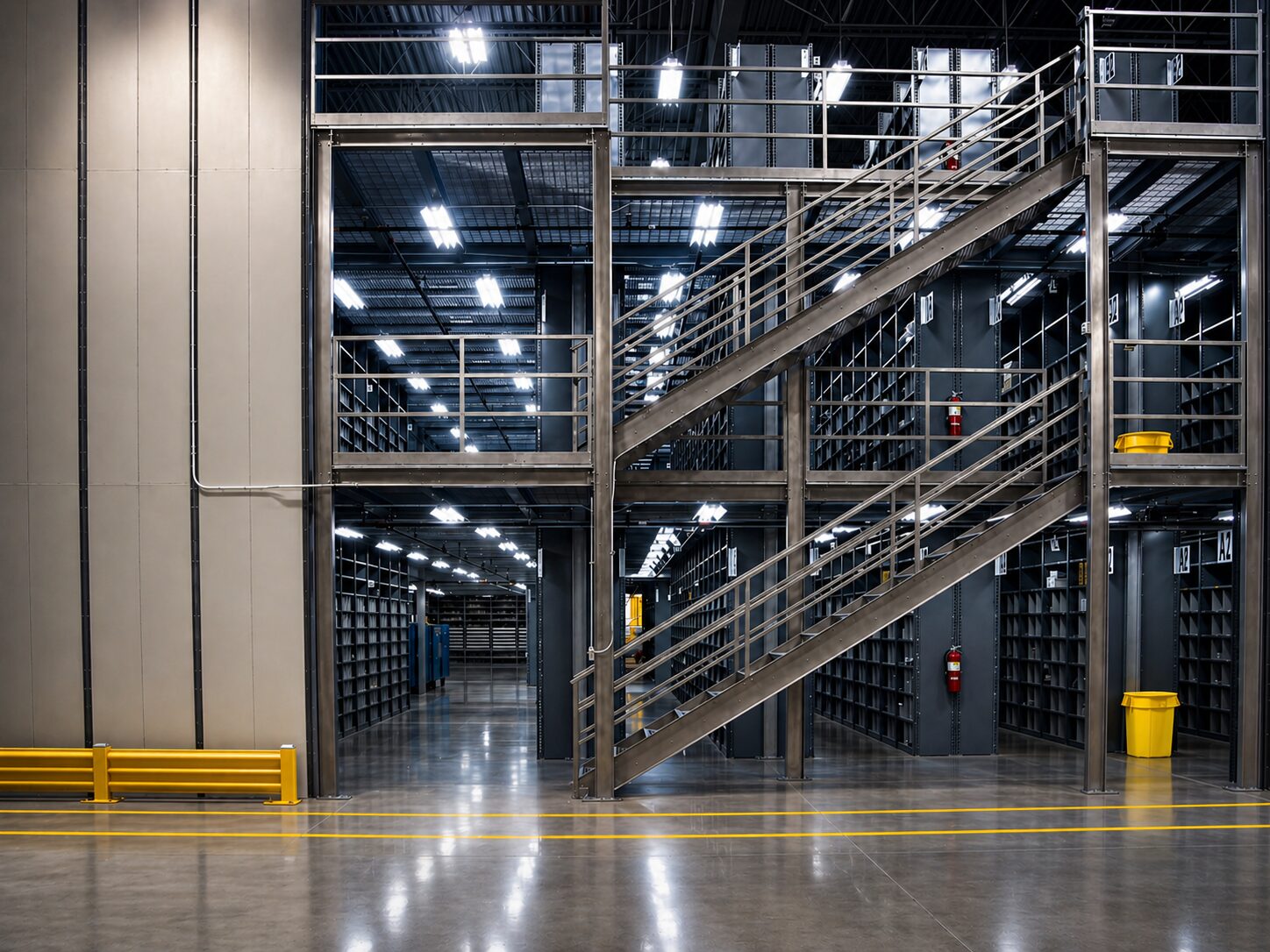
The goal isn’t just to build up.
It’s to build smarter.
A Better Way to Look at Your Facility
If your operation is feeling tight, it’s worth stepping back and asking:
• How much vertical space are we actually using? • Are we maximizing our building’s full capacity? • Is our layout forcing unnecessary movement?
Because the answer might not be more space.
It might be better use of the space you already have.
Final Thought
The most valuable storage space in your facility might be the space you’re not using.
And once you start thinking vertically, it’s hard to go back.
Want to See What’s Possible?
Take a closer look at how vertical storage can transform your operation at Borroughs.com or call 800.748.0227.
